
EPR registration is the mandatory process by which producers, importers, brand owners, and manufacturers register with India’s Central Pollution Control Board (CPCB) portal to formally accept legal responsibility for collecting and recycling the end-of-life waste generated by their products — including plastic packaging, e-waste, batteries, and tyres.
Extended Producer Responsibility (EPR) was introduced under India’s Ministry of Environment, Forest and Climate Change (MoEFCC) framework. EPR registration is now compulsory for businesses that fall under the notified waste categories, and operating without a valid EPR certificate in 2026 can result in penalties, shipment holds at customs, and escalating compliance targets.
At Afleo, we’ve processed EPR registrations for over [X] businesses across plastic, e-waste, and battery categories. This guide reflects the actual CPCB process as of 2026, including portal changes and current processing timelines.
[Learn more about EPR Certificate]
Who Needs EPR Registration in India?
EPR registration is required if your business falls into any of these categories and handles products that generate regulated waste:
| Business Type | Examples | Applicable Waste Category |
|---|---|---|
| Producer | Packaging manufacturers, electronics OEMs | Plastic, E-waste, Battery, Tyre |
| Importer | Businesses importing electronics, batteries, packaged goods | E-waste, Battery, Plastic |
| Brand Owner | Companies that sell products under their own brand | Plastic packaging, E-waste |
| Manufacturer | Units producing plastic-packaged goods | Plastic, Battery |
| E-commerce Seller | Online sellers with product packaging | Plastic packaging |
Not sure if you need to register? The threshold depends on your annual turnover and product category. Contact Afleo for a free eligibility check — most importers are surprised to find they qualify.
[More Info about CPCB guidelines here]
Documents Required for EPR Registration
Prepare these documents before starting your EPR application on the CPCB portal. Having them ready reduces processing time significantly.
| Document | Purpose | Format |
|---|---|---|
| PAN Card | Unique business identification | Scanned copy, PDF |
| GST Registration Certificate | Proof of legitimate business operations | |
| CIN (for registered companies) | Company identification under Companies Act | |
| Product details & HS codes | Defines waste category applicable to your products | List / document |
| Authorised Signatory ID + Designation letter | Identifies the person authorised to sign EPR submissions | |
| Pollution Control Board Consent (if applicable) | Required for businesses generating hazardous waste | |
| Brand / product catalogue | Confirms products generating plastic/e-waste/battery waste | PDF or images |
Pro tip from our team: The most common reason for EPR application rejection or delay is uploading documents with poor scan quality or mismatched names between PAN and GST. Use clear, named PDFs for each document.
EPR Registration Process: Step-by-Step (How to Apply)
The full EPR application process takes place online on the CPCB portal. Here is the exact sequence of steps:
Step 1 — Visit the CPCB EPR Portal
Go to the CPCB official portal at cpcb.nic.in. The portal hosts separate registration modules for each waste category. Identify the correct module for your waste type before creating your account.

Step 2 — Select the Correct Waste Category
This step is critical. Selecting the wrong category leads to incorrect compliance targets and may require re-registration. Choose from:

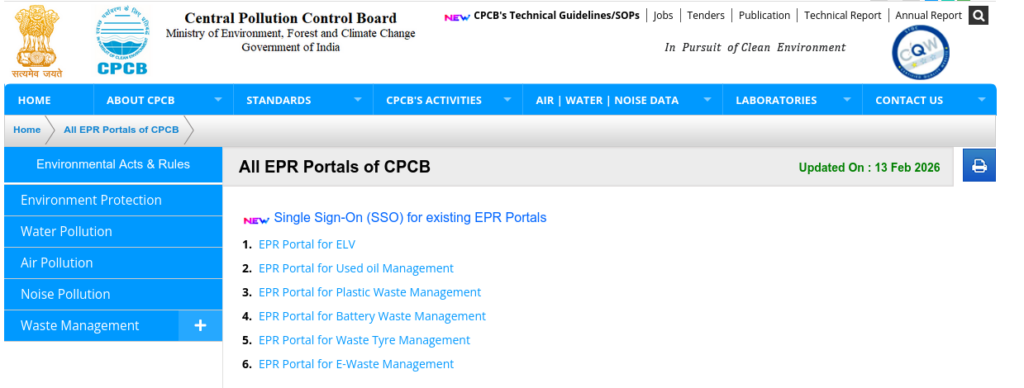
Choose from:
- Plastic Waste — for packaging, carry bags, multi-layer plastic
- E-Waste — for electronics and electrical equipment
- Battery Waste — for all battery types (automotive, industrial, portable)
- Tyre Waste — for tyre manufacturers and importers
- Used Oil Waste — for lubricant producers and recyclers
Note: CPCB has included new option of Single Sign in option if you have exiting account.
Step 3 — Create Your CPCB Account
New users must register on the CPCB portal before submitting an EPR application. You will need:
- Company name (exactly as on your GST certificate)
- Registered address
- Authorised signatory mobile number (for OTP verification)
- Email address (used for all CPCB correspondence)
Step 4 — Complete the EPR Registration Form
The registration form asks for detailed information about your business operations, including:
- Annual quantity of products placed on the market (in metric tonnes)
- Types of waste generated
- Existing waste management arrangements
- Details of Producer Responsibility Organisations (PROs) you work with, if any
Enter accurate figures. Your EPR annual targets are calculated directly from the quantities you declare at this stage. Under-declaring to reduce targets carries a high risk of penalty during audits.
Step 5 — Upload Required Documents
Upload each document listed in the requirements table above. Ensure:
- File size is within the portal’s limit (usually 2 MB per file)
- Documents are legible and not password-protected
- The name on PAN and GST match exactly
Step 6 — Pay the Registration Fee
EPR registration fees vary by category and business scale. As a general reference:
| Category | Approximate Fee Range (2026) |
|---|---|
| Plastic Waste (Producer/Importer) | ₹5,000 – ₹25,000 |
| E-Waste | ₹10,000 – ₹50,000 |
| Battery Waste | ₹10,000 – ₹30,000 |
| Tyre Waste | ₹10,000 – ₹50,000 |
Fees are subject to revision by CPCB. Verify the current fee on the portal before payment.
Payment is accepted via the CPCB portal’s integrated payment gateway (net banking, NEFT, or UPI).
Step 7 — Submit and Track Your EPR Application Status
After submission, save your application reference number. You can use this to track your EPR application status directly on the CPCB portal under the “Application Status” section.
How to check EPR application status:
- Log in to your CPCB portal account
- Navigate to “My Applications”
- Your current status will show as: Submitted → Under Review → Additional Information Required → Approved
CPCB may raise queries requesting additional documents or clarification. Respond within the stipulated timeframe to avoid application lapse.
EPR Application Processing Time & Certificate Validity
| Milestone | Typical Timeline |
|---|---|
| Initial review by CPCB | 5–7 working days |
| Queries raised (if any) | 7–15 working days after submission |
| Full approval (no queries) | 15–20 working days |
| Full approval (with queries) | 25–40 working days |
| Certificate validity | 1 year from date of issue |
| Renewal timeline | Initiate 60 days before expiry |
From our experience handling 100+ EPR registrations: Applications where documents are complete and quantities are accurately declared are typically approved within 15–20 working days. Applications with quantity discrepancies or scanned documents of poor quality routinely take 35–40 days.
Smarter Shipping Begins Now – Discover Our Complete Digital Freight Platform.

Post-Registration EPR Compliance Obligations
Obtaining your EPR registration certificate is the beginning, not the end. Here is what you are required to do after registration:
Annual EPR targets: Each registered entity receives annual recycling/collection targets based on their declared quantities. You must meet these targets by partnering with CPCB-approved recyclers or PROs.
Quarterly and annual returns: You must file quarterly reports on the CPCB portal detailing waste generated, waste handed over for recycling, and recycling certificates received. Missing a quarterly return attracts escalating penalties.
Record keeping: Maintain recycling certificates, PRO contracts, and waste handover documents for a minimum of 5 years. CPCB conducts inspections and these records are your primary compliance evidence.
EPR certificate renewal: The EPR registration certificate is valid for one year. The renewal process mirrors the original application. Begin 60 days before expiry — late renewals create a compliance gap that is reportable at customs.
Common EPR Registration Mistakes to Avoid
Based on the EPR applications we handle at Afleo, these are the errors that delay or derail registrations most often:
Wrong category selection — Registering under plastic waste when your product should be e-waste, or vice versa, leads to incorrect targets and potential re-registration. If in doubt, check the CPCB’s product classification guide or ask a consultant.
Quantity under-declaration — Some businesses declare lower quantities thinking it reduces their compliance burden. This triggers mandatory audits and Environment Compensation (EC) penalties that far exceed the original target cost.
Document name mismatch — If your company’s name on the PAN differs even slightly from the GST certificate (e.g. “Pvt. Ltd.” vs “Private Limited”), CPCB raises a query. Resolve these before applying.
Missing PCB consent — Businesses that generate hazardous co-waste alongside their primary waste stream (e.g. solvents used in electronics manufacturing) often forget the Pollution Control Board consent requirement.
Post-registration inactivity — Some companies register, receive their certificate, and then file nothing. Missing quarterly returns creates a compliance deficit that compounds annually and makes renewal extremely difficult.
EPR Registration for Importers — Special Considerations
EPR registration for import is one of the most queried topics on the CPCB portal. If you import products into India that fall under notified waste categories, you are treated as a “producer” under EPR rules and must register before your goods clear customs.
Key points for importers:
- Your EPR certificate may be required at the time of customs clearance for regulated product categories
- Importers of e-waste covered products (computers, phones, televisions) must register under the EPR for E-Waste
- Importers of batteries must register under EPR for Battery Waste Management Rules 2022
- The quantity you declare should reflect your annual import volume in metric tonnes
Afleo’s team has helped importers at JNPT, Mundra, and Hazira ports obtain EPR certificates that met customs requirements. Get in touch if you have an urgent shipment pending clearance.
Need Help with EPR Registration? Afleo Handles It End-to-End
Navigating the CPCB portal, selecting the correct waste category, ensuring documents match, declaring accurate quantities, and meeting post-registration compliance deadlines — this is a process where small errors have large consequences.
Afleo’s EPR compliance team has processed registrations across plastic, e-waste, battery, and tyre categories for manufacturers, importers, and brand owners across India. We handle everything from initial eligibility assessment to certificate receipt and ongoing return filing.
What we do:
- Free eligibility and category assessment
- Document preparation and verification
- CPCB portal submission and query management
- Post-registration quarterly and annual compliance filing
- EPR certificate renewal
Let Afleo be your trusted compliance partner.
Contact us today to get started with hassle-free EPR registration and management!