Advance Authorisation Scheme (Advance License Scheme)
List of Services
AFLEO Consultants DGFT Regional office
- IEC and its modification/Yearly Update/IEC Surrender.
- Revoke IEC from DEL, Suspension, Cancellation etc / Merger/Demerger of IEC’s.
- DGFT Identity card.
- Advance License - Issuance and Redemptions
- Export Promotion Capital Goods (EPCG) License – Issuance and Redemptions
- Duty-Free Import Authorization (DFIA)
- Remission of Duties or Taxes on Export Product (RoDTEP)
- Merchandise Exports from India Scheme (MEIS)
- Services Exports from India Scheme (SEIS)
- Rebate of State and Central Taxes and Levies (RoSCTL)
- Transport and Marketing Assistance (TMA)
- Certificates of Origin (COO) – SAPTA, APTA, ISLFTA, GSTP, India–Dubai CEPA, etc.
- Import Monitoring System (IMS) – Steel IMS, Coal IMS, Copper/Aluminium IMS, Chip IMS
- Deemed Export Benefits – Apply for Refund of TED/DBK/Brand rate Fixation.
- Star Export House Certificate.
- Free Sale & Commerce Certificate, End User Certificate.
- Enforcement cum Adjudication Proceedings at RA Mumbai.
- E-RCMC Certificate from DGFT – APEDA, FIEO, EEPC, PHARMEXCIL, CHEMEXCIL ETC.
- Gems & Jewelry Schemes.
- Application for Interest Equalization Scheme.
- REX Registration.
- FREE SALE AND COMMERCE CERTIFICATE.
- Abeyance Cases for IEC’s in DEL.
- END USER CERTIFICATE.
DGFT HQ, New Delhi
- Norms Fixation - Handling 25+ Norms Fixation cases every month across various Product groups. (Engineering, Pharmaceutical, Chemical, Textiles & Leather, Plastic & Rubber, Food, Sports & Misc. products)
- Policy Relaxation Committee (PRC Matters) - Proudly representing 20+ cases every month.
- EPCG Committee Approvals - Handling 10+ complex cases every month
- Permission for Restricted/Negative list of Import Items & Export Items - Experience in Handling 100+ cases till date.
- Registration Certificates for Export & Import Items.
- SCOMET Licenses.
- TRQ (Tariff Rate Quotas)
- Appeal Matters under FTP.
Custom Related Services
- AA/EPCG/DFIA License Registration.
- Bond & Bank Guarantee (BG) Cancellation of EPCG/Advance License.
- ICEGATE Registration.
- Refund under Section 74.
- Pending Duty Drawback from Customs.
- Factory stuffing– Self-sealing permission. [FSP]
- Pending IGST Refund from Customs.
- Removal of IEC from the Alert list of Customs.
- GST Services – Refund of ITC from GST.
- Authorized Economic Operator (AEO T1, T2 & T3) certification.
- Reply & Follow-up of Customs Notices if any.
- GST Services – Refund of GST for Service Exporters.
- AD Code/IFSC Registration.
- SIIB Matters (Special Investigation and Intelligence Branch)
- SVB Matters.
- Registration Procedures for First-time Importers/ Exporters
- DPD/DPE Registration.
Other Certification:
- All Types of Digital Signature Certificates.
- Health Certificate for Export Products
- EPR Certification for Producers, Importers and Brand owners.
- Phytosanitory Certificate.
- BIS Certification.
- Banking & RBI related liaison for Exporters & Importers.
AFLEO logistics
- Sea Cargo Consolidation – Import & Export
- Sea Freight Forwarding - Import & Export
- Air freight - Import & Export
- Land freight
- Warehousing
- Customs clearance
- Insurance
AFLEO Global
- Buying of scrips - MEIS / SEIS / RoDTEP / RoSCTL / DFIA
- Selling of scrips - MEIS / SEIS / RoDTEP / RoSCTL / DFIA
Find our brochure for more details:
Table of Contents
Advance Authorisation Scheme (Advance Authorisation License Scheme)
- What is Advance Authorisation Scheme
- Latest Updates on Advance Authorisation Scheme
- What can be imported duty-free under Advance Authorization Scheme?
- Duties Exempted under the Advance Authorisation Scheme.
- Eligibility Criteria for Advance Authorisation Scheme DGFT.
- What is the Advance License for Deemed Exports?
- Methods for issuing Advance License.
- Standard Input-Output Norms (SION Norms)
- Self-Declared Norms
- Applicant Specific- Prior Fixation of Norms
- Self-Ratification Advance Authorisation Scheme
- Documents required for applying for an Advance license from DGFT
- Advance License scheme procedure
- How can we assist you for Advance Authorisation Scheme?
- Important Terms & conditions under Advance Authorisation Scheme.
- Actual User Condition under Advance Authorisation Scheme.
- Pre-Import Condition under Advance Authorisation Scheme.
- Value-Addition under Advance Authorisation Scheme.
- Invalidation Letter under Advance License.
- Redemption of Advance License / EODC.
- FAQ
- Why Afleo Consultants?
What is Advance Authorisation Scheme
The Advance Authorisation Scheme is a duty exemption scheme where exporters can import raw materials and input materials for manufacturing export products without paying customs duty.
The scheme helps reduce production costs for exporters and improves the global competitiveness of Indian export products. By saving import duties on imported inputs, manufacturers can produce export goods at lower costs and compete more effectively in international markets.The scheme is also popularly known as the advance licence or advance license scheme, reflecting older terminology used in trade circles. This synonym may be more familiar to some exporters and advisors.
Latest Updates on Advance Authorisation Scheme
- Public Notice No. 07/2026-27 dated 05 May 2026: DGFT has extended the validity of ad-hoc norms ratified by the Norms Committee under the Advance Authorisation Scheme till 31 March 2028. Earlier valid up to 31 March 2026, the extension aims to ensure continuity, reduce transaction costs, and facilitate ease of doing business for exporters. For more details, click here to download the PDF notification.
- Public Notice No. 51/2025-26 Dated 6th March 2026:
Extension in the Export Obligation Period for Advance Authorisations – The Directorate General of Foreign Trade (DGFT) has extended the Export Obligation Period (EOP) for Advance Authorisations, including Advance Authorisation for Annual Requirement and Special Advance Authorisation. If the Export Obligation period (original or extended) was expiring between 1st March 2026 and 31st May 2026, it will now stand automatically extended up to 31st August 2026. This measure has been introduced to support exporters impacted by global supply chain disruptions. The extension will be granted automatically without the need for filing any application or payment of additional fees. - 20th March 2025 – The support under RoDTEP Scheme for exports of products manufactured from Advance License Holders, EOU’s, SEZs has been extended upto 05.02.2025 only. From 06.02.2025 onwards export from these categories will no longer be eligible for RoDTEP support.
What You Get: Key Benefits
| Duty/Tax | Exemption Status |
|---|---|
| Basic Customs Duty | Exempt |
| Additional Customs Duty (CVD) | Exempt |
| Anti-Dumping Duty | Exempt |
| Countervailing Duty | Exempt |
| Integrated GST (IGST) | Exempt |
| Compensation Cess | Exempt |
- Cash-Flow Relief: Importing without paying duties up front eases your working capital burden and improves pricing power.
- Competitive Edge:Lower costs translate to more competitive export pricing and better market access.
- Flexibility:You can import not only raw materials but also fuel, catalyst and packaging materials if they are used in the export product, provided norms support their use.
What can be imported duty-free under Advance Authorization Scheme?
In the Advance Authorisation Scheme, the exporter can import raw materials duty-free. As per Chapter 9 of FTP para, 9.44 “Raw material” means input(s) required for the manufacturing of goods. These inputs either can be in a raw/natural/unrefined/unmanufactured or manufactured state. Hence, Advance License is issued to allow duty-free import of inputs, which is physically incorporated in export products (after making normal allowance for wastage). In addition to this, fuel, oil, the catalyst which is consumed/utilized in the process of production of export product, may also be allowed.
Duties Exempted under the Advance Authorisation Scheme.
Imports under Advance License are exempted from the payment of Basic Customs Duty (BCD), Additional Customs Duty, Education Cess, Anti-dumping Duty, Countervailing Duty, Safeguard Duty, Transition Product Specific Safeguard Duty, wherever applicable. Under the Advance Authorisation, imports for physical exports are also exempted from the whole of the integrated tax and Compensation Cess and such imports shall be subject to pre-import condition. Imports against Advance Authorisations Scheme for the physical exports are exempted from Integrated Tax and Compensation Cess up to 31.03.2020 only. As per Notification No. 57/2015-20 dated 31.03.2020, this exemption is renewed till 31.03.2021.
Eligibility Criteria for Advance Authorisation Scheme DGFT.
Since Advance Authorisation Scheme comes with an actual user condition, it can be issued to either manufacturer exporter or merchant exporter tied with a supporting manufacturer.
As per the Para 4.05(c) of the FTP, Advance Authorisation is issued for:-
- Manufacturer Exporters: producing goods for export.
- Merchant Exporters: tied to supporting manufacturers.
- Actual/Deemed Exporters: under specific chapters of the Foreign Trade Policy, such as export to projects or supply under international competitive bidding.
- Supply of ‘stores’ on board of foreign going vessels/ aircraft.
Not Covered
- Safeguard Duty and Transitional Product Specific Safeguard Duty generally remain payable.
- You cannot use AAS to import capital goods; for that, you must use the Export Promotion Capital Goods (EPCG) scheme.
Watch this short video on the Advance Authorisation Scheme which explains How does the scheme work? Who all are eligible to claim, its application process, export obligation & EODC/Redemption procedures & finally how can we at Afleo Consultants help you in getting Advance License benefits from the Govt.
What can be imported duty-free under the Advance Authorisation Scheme?
Under the scheme you can import a range of raw materials and consumables duty-free. These typically include:
- Raw materials and components – metals such as steel, aluminium and copper; chemicals like acids, solvents and dyes; plastic polymers and textiles that are physically incorporated into the export product.
- Fuel, oils and catalysts – furnace oil, lubricants, gases and other catalysts consumed during the production process.
- Packaging materials – corrugated boxes, HDPE bags, labels, shrink films, adhesives and other packaging needed for the final export product.
- Spare parts and tools – spares, jigs and fixtures that must accompany the export product, limited to 10 % of the CIF value.
- Special items – biotechnological inputs approved by the relevant authorities and certain spices when they are crushed, ground, sterilised or processed into oleoresins. Special advance authorisations also allow duty-free import of fabric used in garments subject to SION norms.
Minimum Value Addition and Export Obligation
Advance Authorisation scheme demands you add a minimum value to the final product and meet export obligations:
- Value Addition (VA) – Usually 15 % for most products. VA is calculated as (FOB value of exports – CIF value of imported inputs) ÷ CIF value × 100. Miscalculating this can lead to recovery of exemption.
- Export Obligation (EO) – You must export finished goods worth at least twice the CIF value of imported inputs within the validity period (commonly 18 months). Failure to meet EO results in penalty and duty recovery.
Application: Step-by-Step Process
Under this advance license scheme, applicants must follow a defined process to secure an advance licence for duty-free imports. The following steps outline how to obtain an Advance Authorisation from the Directorate General of Foreign Trade (DGFT)
- Register on the DGFT portal using your Importer-Exporter Code (IEC) and obtain a Class III digital signature.
- Gather documents – Production and consumption data certified by a chartered accountant, technical specifications of the product, and past export performance. For non-SION products, prepare a detailed input-output ratio.
- File online application (ANF 4A) on the DGFT portal. Attach supporting documents and self-declared norms if no SION exists.
- Select Norms – Choose Standard Input Output Norms (SION) if available, or apply for ad-hoc norms fixation. Incorrect norms can lead to rejection.
- Pay the application fee as prescribed.
- Submit and track – After submission, monitor application status through the DGFT portal. Authorities may ask for clarifications.
Once authorised, you can import inputs duty-free. Customs will require you to furnish bond/bank guarantee against the export obligation.
What is the Advance License for Deemed Exports?
- Deemed Export: Deemed Export refers to the supply of finished goods that do not leave the country, and the payment of transaction can be in INR or free foreign exchange.
- Following are the categories of supply that are considered as Deemed Exports:
- Supply of goods to EOU / STP / EHTP / BTP units.
- Supply of goods against Advance Authorization / Advance Authorization for
annual requirement / DFIA - Supply of Capital Goods/Machinery against EPCG Authorization.
- Supply to other Government Funded projects, etc.
- One can apply for an Advance License for Deemed exports from the DGFT office.
Methods for issuing Advance License.
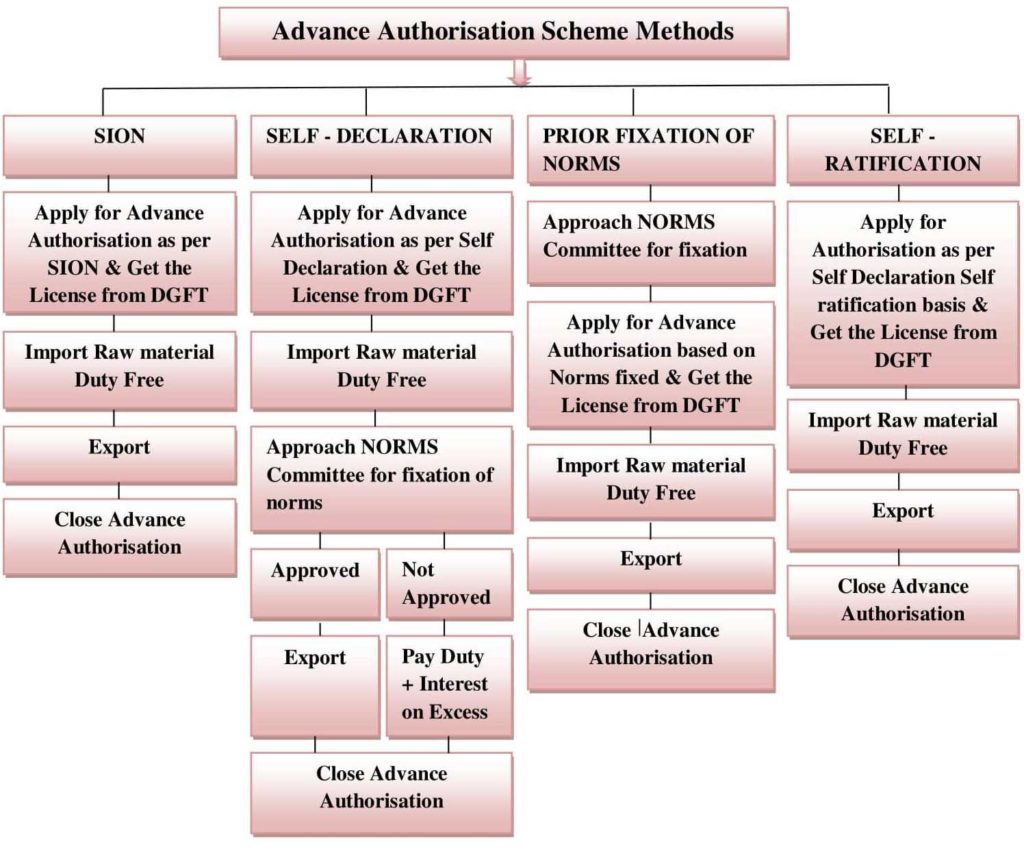
An exporter can apply for fresh Advance Authorisation by four ways-
- SION (Standard Input and Output Norms).
- Based on Self-Declared Norms, to be approved subsequently (Under Para 4.07 of HBP, Ad-hoc Norms).
- Applicant Specific Prior-Fixation of Norms by the Norms Committee.
- Based on Self-Declaration & Self-Ratification. (Self-Ratification Advance Authorisation Scheme).
Norms Fixation and Self-Ratification
When no SION covers your product, you must apply for Ad-hoc Norms. This involves submitting production details, input consumption data and a manufacturing flowchart. DGFT will assess and notify the norms. Exporters with Authorised Economic Operator (AEO) status may avail Self-Ratification, allowing them to declare norms and import inputs without waiting for DGFT approval.
Compliance Obligations
- Monitoring – Maintain accurate records of imported inputs and production. Customs can audit to verify input usage.
- Fulfil EO – If you cannot export within the time frame, apply for EO extension before expiry. Failing to do so results in duty demand with interest.
- Transfer Restrictions – Goods imported under AAS cannot be transferred or sold domestically until EO is fulfilled. Misuse leads to penalties.
Latest Updates
Recent policy circulars emphasise stricter monitoring of value addition and misuse of exemptions. DGFT is digitising the entire process, so paperless applications and electronic exchange of documents are now standard.
Common Pitfalls to Avoid
- Applying without understanding value addition formula leads to shortfall and penalty.
- Using wrong HS codes or norms can delay or reject your application.
- Failing to track the EO period; missing deadlines triggers duty recovery.
- Inadequate record-keeping of inputs and exports; audits can demand proof years later.
Documents required for applying for an Advance license from DGFT
Documents for filing Advance Authorisation application depends as per the above four methods. Please find below basic Important documents required-
- DGFT DSC.
- Copy of IEC.
- Application form ANF – 4A.
- Copy of SSI/IEM/MSME
- Copy of Export House Certificate (if applicable)
- Copy Valid RCMC
- Copy of GST Certificate.
Advance License scheme procedure
Please find an image below which explains all the above four methods in a simple and easily understandable manner-
Please find below procedure for online application of Advance Licence:
- Prepare documents as per the above-mentioned list of documents.
- Visit the DGFT Official Website- www.dgft.gov.in.
- Login with DSC & Select Services from Online Ecom Application.
- Click on Advance Authorisation (DES).
- Fill all the details and upload the necessary documents.
- Kindly note that the following important points to be noted to make sure the
documents are prepared error-free:- IEC/RCMC should show the applicant as a manufacturer exporter.
- IEC/RCMC should have the address where the raw materials are proposed to
be taken for processing. - MSME/SSI/Manufacturing proof should have the export products listed in the
Advance License.
- After filling all the details, submit the application.
- After a successful application, DGFT will issue the Advance License.
How can we assist you for Advance Authorisation Scheme?
Our experts assist you in getting Advance License Benefits from DGFT & Customs as under:
- We help you in preparing documents for application of Advance License.
- Obtaining Advance License from Director General of Foreign Trade.
- Guiding regarding the procedural requirement & Compliances to be followed by the Client after issuance of Advance Authorization.
- Obtaining Amendment, Enhancements or Extension for the Advance License.
- Getting Redemption Letter from DGFT RA and release of Bond after fulfilling the export obligation from Customs.
Important Terms & conditions under Advance Authorisation Scheme.
The benefit under Advance Authorisation scheme comes with certain terms and conditions, please find them below:
- Items prohibited for exports or imports are not allowed under AA.
- AA is issued Subject to Actual User Condition.
- Inter Unit Transfer of Inputs permitted.
- 15% is the minimum Value Addition to be achieved.
- Certain products have less/more Value Addition.
- Certain categories of Inputs are ineligible for benefits.
- Free of cost Material permitted for imports.
- Duty Drawback shall be available for only duty paid inputs used. (All Industry Rate of Drawback will not be available)
- Import of restricted items shall also be allowed under Advance Authorisation (AA) Scheme.
Actual User Condition under Advance Authorisation Scheme.
The material imported under Advance Authorisation shall be subject to the “Actual User” condition. It means that the material cannot be transferred and it has to be used in the premises of the License holder only. It is not transferrable even after the completion of Export Obligation (EO). However, the Advance License holder will have the option to dispose of/sell products manufactured out of duty-free input once the Export Obligation is completed.
Pre-Import Condition under Advance Authorisation Scheme.
It means that the raw material should be imported first; physically incorporated in the export product and then the export should take place. You cannot export first using the duty paid material that you have and then Import raw material duty-free. This is not allowed. Items that have the pre import condition have been indicated in Appendix 4J or SION Norms List.
Value-Addition under Advance Authorisation Scheme.
Value Addition shall be:
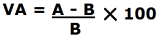
Where,
A = FOB value of export realized or the FOR value of supply received.
B = CIF value of inputs covered by the authorisation, plus the value of any
other input used on which benefit of DBK is claimed or intended to be claimed.
Invalidation Letter under Advance License.
In case the exporter does not want to import directly under Advance Authorisation, i.e. he wants to procure raw materials indigenously from a domestic supplier. Then he/she needs to invalidate the Advance License for direct import and obtain the Invalidation letter from DGFT. Invalidation Letter is issued by DGFT RA at the time of Advance Authorisation or subsequently. The validity of the Invalidation letter is co-terminus with the validity of Advance Authorisation.
Redemption of Advance License / EODC.
On completion of the imports and exports, the license holder shall submit an application in ANF-4F for the Redemption of the Advance Authorisation License. The Regional Authority of DGFT will verify the completeness of the Application in all aspects. If Export Obligation (EO) and other conditions have been successfully fulfilled, the Regional Authority (RA) will issue the EODC (Export Obligation Discharge Certificate)/ Redemption Certificate to the Authorisation holder.
[ To know each and every detail about the EODC/Redemption of Advance Authorisation online on the newly launched DGFT portal watch the complete video given below- ]
FAQ’s
What is the Advance license/ Advance Authorisation Scheme?
To increase export from the country, our Government has introduced
various schemes. And one of them is the Advance Authorisation Scheme or also
known as the Advance License., in which we can import raw materials/inputs
required for the production of the export product at Zero Custom Duty, i.e., duty-
free. Oil, and catalyst, utilized in the process of production of export products, may also be allowed for duty-free import. An Export Obligation is set as a condition for
issuing the Advance License.
What is the Advance Authorisation Scheme under the GST?
The Advance Authorisation Scheme is in place for the last 20-30 years. However, after the GST law has passed, there are many modifications done under the scheme. Earlier, the duties exempted include Basic Customs Duty, CVD, SAD, etc. However, for the Advance Authorisations Scheme under the GST, the import duties exempted include the Basic Customs duty, Integrated GST (IGST), Compensation Cess, etc. Exemption from payment of IGST and Compensation Cess is granted with following conditions:
- Only when AA is taken for physical exports.
- Imports that are exempted will be subject to pre-import conditions.
- The exemptions are valid only till 31.03.2021 (the date may change. Please
refer to the latest notification).
How do I apply for the Advance Authorisation Scheme?
One can apply for the Advance License from Directorate General of Foreign Trade (DGFT) on the following basis- SION, Self-Declaration, Prior Fixation of Norms by Norms Committee, and By Self-Ratification Basis. While applying online, we will require a digital signature of the applicant. The applicant can be a manufacturer exporter or Merchant Exporter. He should have IEC and RCMC with the factory address mentioned. In the case of Merchant Exporter, supporting manufacturer details should be mentioned. We need to fill the online form ANF 4A and upload the required documents.
How does Advance License work?
Please find the below steps that show the entire working of Advance
License Scheme –
- First, we need to apply for an Advance Authorisation at the Jurisdictional DGFT
office. - The Advance License issued from the DGFT will have all the details like
Export/Import Item description, HS Code, Quantity, FOB/CIF Value on it. - Then the said License should be registered at Customs – Port of Registration.
- Along with the registration, Exporters need to executive Bond/LUT with the
Customs Authority. - Then the raw materials can be imported duty-free and should be taken to
factory premises for the production of the export item. - Once Export Obligation under the Advance Authorisation scheme is completed,
the License can be closed, and Bond can be cancelled.
What is the DEEC Scheme?
Duty Exemption Entitlement Certificate Scheme (DEEC Scheme) is an export promotion scheme, which enables duty-free import of inputs required for the manufacture of export products. DGFT issue Advance License to manufacturer/merchant exporter under DEEC Scheme for import of inputs at zero customs duty.
What is the difference between EPCG & Advance License?
For importing duty-free raw materials, the exporter has to take Advance License. To import Capital goods duty-free, the exporter has to take EPCG License.
What is the difference between Advance Authorisation Scheme & Duty Drawback?
In Advance Authorisation, the exporter can import raw materials duty-free, i.e. zero custom duty. In Duty Drawback, the exporter has to pay all the customs duty while importing and then after exporting he can request for refund of customs duty.
What is the difference between Advance Authorisation Scheme & Duty- free Import Authorisation scheme (DFIA)?
Advance Authorisation Scheme(AAS) | Duty-Free Import Authorisation Scheme (DFIA) |
| In AAS, Exporter will receive a license, and then he will import and export | In DFIA, Exporter will export against file number, and then import license will be issued as per export. It is a post-export benefit. |
| In AAS, License received is not transferable. | In DFIA, License received is transferable. |
How to get Advance License from DGFT?
The Exporter has to fill online application form ANF 4A with the above relevant documents. We have experts who can help you to fill online application and to prepare documents as per DGFT guidelines and follow-up to get Advance License from DGFT.
What are the application fees for applying under Advance Authorisation Scheme?
For applying Advance Authorisation, the application fee depends on the CIF value of the Import product.
What is an Export Obligation under Advance Authorisation?
Duty-Free import benefit under Advance Authorisation comes with the commitment to Export certain pre-defined quantity and value of goods after using the imported raw material. This commitment to export is known as Export Obligation.
The Export Obligation under Advance Authorisation Scheme is of two types:
- Quantity-wise Export Obligation – Quantity of export made should be
proportionate to the number of imports made, as per Norms. - Value-wise Export Obligation – 15% Value addition has to be compulsorily
maintained in the Advance Authorization Scheme. - Note: Different value addition method can be prescribed for the Gems and
Jewelry sector, Tea, etc.
What is Export Obligation Period under Advance License?
- The period of fulfillment of Export Obligation in Advance Authorisation is 18
months from the license issue date. - In the case of Deemed Export, the Export Obligation period depends on the
completion of the project. - But in case of exporting products related to defense, military store, aerospace,
and nuclear energy, the Export Obligation period will be of 24 months or co-
terminus with contracted duration of the export order whichever is more. - Also, please find below the import product list with their Export Obligation
period specified by DGFT as per Appendix 4J-Sr.No. Import Product List Export Obligation period 1 Spice
(a) Pepper; cardamom and chilies for Value Addition purpose like crushing / grinding /sterilisation or for manufacture of oils and oleoresins and not for simple cleaning, grading, repacking etc.
(b) Spices other than pepper, cardamom and chilies for manufacture of Spice oils. Oleoresins
(c) Other than (a) & (b) above.120 days However, for imports completed up to 31.12.2008, Export Obligation Period (EOP) shall be 150 days.
12 months.
90 days
2 Drugs (with a specific export order and pre-import condition) 12 months. 3 Penicillin and its salts [ITC(HS) Code No. 29411010] 12 months. 4 Tea 6 months. 5 Coconut Oil 90 days 6 Silk in any form 9 months. 7 Drugs from unregistered sources 12 months. 8 Precious Metal/Gold/Silver/Platinum 120 ys
Export Obligation product list BY DGFT
What is Standard Input-Output Norms (SION norms under Advance Authorisation)?
Standard input-output norms, in other words, we can say the standard norms which define the quantity of inputs/raw materials required to manufacture one unit of the export product. Under the SION, Norms for thousands of products falling under the different segments like chemical and allied products, electronics, Engineering, food products, handicrafts, leather, plastics, sports, textile, etc. are pre-defined by the DGFT.
What is Advance Authorisation for the annual requirement?
As the name suggest, Annual Advance authorisation is taken by an exporter for his/her annual requirements. This provision of an annual license is given to avoid issuance of a large number of the Advance Authorisation by an exporter for a particular year. Thereby reducing compliance and saving time. However, there are specific criteria to be eligible for the application under the Advance Authorisation for the annual requirement. They are:
- Applicant should have made exports in at least preceding two Financial Years.
- The maximum entitlement of CIF would be 300% of the FOB value of previous FY or 1 Cr whichever is higher.
- It can only be applied for the products which are in SION or Adhoc Norms fixed category.
What is Special Advance Authorisation Scheme?
In Special Advance Authorisation Scheme, we can import duty-free fabric for the export of articles of apparel and clothing accessories. The exporter can apply as per SION. The Authorisation holder can import relevant fabrics and no other inputs like
packing material, fuel, oil, and catalyst will be allowed to import under this Special Advance Authorisation. The fabric imported against the authorisation is as per actual user condition and it is non-transferable also after fulfillment of Export Obligation. But it is transferable for job work if any. Duty Drawback would also be available on the other domestically procured inputs.
The benefit of the Advance License scheme and Duty Drawback (AIR – All Industry rate) can be taken simultaneously or not?
No, benefit under both schemes cannot be taken simultaneously. You can choose only one scheme. Carefully calculate the benefit under each scheme and then make a decision.
What will happen if some of the raw materials are imported under AA, and other raw materials are either domestically procured/or duty paid imported raw material are used in the manufacture of the export product? How to claim Duty Drawback on inputs not covered under AA?
In such cases, you can claim the brand rate of Duty drawback on domestically procured/or duty paid imported raw material. At the time of making an application for Advance Authorisation Scheme, you have to indicate details of such duty paid inputs. The process is called brand rate fixation of duty drawback.
Can raw material be procured locally?
Yes, raw materials can be procured domestically. In such cases, DGFT will issue an Invalidation letter to invalidate the license for direct import. In some cases, DGFT may also issue an Advance Release Order (ARO).
How much time does it take to get an Advance license from DGFT?
It typically takes 15-20 working days to get Advance License from DGFT. We have experts who can accurately prepare documents as per DGFT’s requirements and get Advance License within 5-10 working days.
Can I apply for multiple RCMCs if I export goods from multiple industries?
Yes, if you export goods from different industries, you may apply for multiple RCMCs corresponding to each industry or alternatively You can apply only with FIEO under Multi Product Category.
How Do I close Advance license from DGFT?
The Exporter has to fill the ANF 4F with relevant export documents to close Advance License.
Do you help in redemption/Closure of Advance license?
Yes, We do have a team who will help you in the redemption of Advance License.
Can we surrender/cancel an Advance license if not used for duty-free import?
Yes, the Authorisation holder can surrender the license if not used to import duty-free.
What is Advance license registration procedure?
On receiving the Advance License from DGFT, the next step would be to register the license at Customs. It is not possible to clear the raw materials duty-free unless you register the license at the port where the consignment will arrive. License is registered to the port of customs as mentioned in the license.
Is it mandatory to register Advance license at Customs?
Yes, it is mandatory to register the Advance License at customs to import duty-free raw materials.
Is Advance License transferable?
No, the Advance License is not transferable even after the holder has fulfilled the Export Obligation. This means that raw materials cannot be transferred even after the Export Obligation is completed. However, finished products made from excess raw materials may be disposed of/sold.
Can we sell Advance license?
No, Advance License is not possible to sell. Also, not after fulfilling an export obligation.
Why Afleo Consultants?
- We only have the goal of providing very reliable services with the most competitive cost to the exporters under one roof.
- Social Media Presence: We wish to get every opportunity to grow our relationships with our clients and for which we made our presence on each social networking sites to update them about the latest Notifications, Circulars, Amendment done in foreign trade policies.
- 24/7 Telephonic Service: We believe in offering better and faster services to our clients who can’t afford to wait until the morning for a problem to be fixed we are just a phone call away, they just need to call or drop a mail and we try to reach them as soon as possible.
- We have a separate team for follow up with DGFT and have a great understanding of the working of DGFT office, which helps us in obtaining & Closing Advance licenses without delay.
Final Thoughts
The Advance Authorisation Scheme is a powerful tool for export-oriented businesses, but it demands strict compliance and good record-keeping. Treat the advance licence as a strategic tool—when used responsibly, the advance license scheme protects your working capital and positions your business for growth. Make sure you understand duties exempted, maintain value addition above the threshold, and follow the DGFT application process carefully. If you need expert help navigating norms fixation or meeting export obligations, reach out to our team. We specialise in AAS compliance and can assist you from application to redemption.