
EPCG Scheme (Export Promotion Capital Goods Scheme)
List of Services
AFLEO Consultants DGFT Regional office
- IEC and its modification/Yearly Update/IEC Surrender.
- Revoke IEC from DEL, Suspension, Cancellation etc / Merger/Demerger of IEC’s.
- DGFT Identity card.
- Advance License - Issuance and Redemptions
- Export Promotion Capital Goods (EPCG) License – Issuance and Redemptions
- Duty-Free Import Authorization (DFIA)
- Remission of Duties or Taxes on Export Product (RoDTEP)
- Merchandise Exports from India Scheme (MEIS)
- Services Exports from India Scheme (SEIS)
- Rebate of State and Central Taxes and Levies (RoSCTL)
- Transport and Marketing Assistance (TMA)
- Certificates of Origin (COO) – SAPTA, APTA, ISLFTA, GSTP, India–Dubai CEPA, etc.
- Import Monitoring System (IMS) – Steel IMS, Coal IMS, Copper/Aluminium IMS, Chip IMS
- Deemed Export Benefits – Apply for Refund of TED/DBK/Brand rate Fixation.
- Star Export House Certificate.
- Free Sale & Commerce Certificate, End User Certificate.
- Enforcement cum Adjudication Proceedings at RA Mumbai.
- E-RCMC Certificate from DGFT – APEDA, FIEO, EEPC, PHARMEXCIL, CHEMEXCIL ETC.
- Gems & Jewelry Schemes.
- Application for Interest Equalization Scheme.
- REX Registration.
- FREE SALE AND COMMERCE CERTIFICATE.
- Abeyance Cases for IEC’s in DEL.
- END USER CERTIFICATE.
DGFT HQ, New Delhi
- Norms Fixation - Handling 25+ Norms Fixation cases every month across various Product groups. (Engineering, Pharmaceutical, Chemical, Textiles & Leather, Plastic & Rubber, Food, Sports & Misc. products)
- Policy Relaxation Committee (PRC Matters) - Proudly representing 20+ cases every month.
- EPCG Committee Approvals - Handling 10+ complex cases every month
- Permission for Restricted/Negative list of Import Items & Export Items - Experience in Handling 100+ cases till date.
- Registration Certificates for Export & Import Items.
- SCOMET Licenses.
- TRQ (Tariff Rate Quotas)
- Appeal Matters under FTP.
Custom Related Services
- AA/EPCG/DFIA License Registration.
- Bond & Bank Guarantee (BG) Cancellation of EPCG/Advance License.
- ICEGATE Registration.
- Refund under Section 74.
- Pending Duty Drawback from Customs.
- Factory stuffing– Self-sealing permission. [FSP]
- Pending IGST Refund from Customs.
- Removal of IEC from the Alert list of Customs.
- GST Services – Refund of ITC from GST.
- Authorized Economic Operator (AEO T1, T2 & T3) certification.
- Reply & Follow-up of Customs Notices if any.
- GST Services – Refund of GST for Service Exporters.
- AD Code/IFSC Registration.
- SIIB Matters (Special Investigation and Intelligence Branch)
- SVB Matters.
- Registration Procedures for First-time Importers/ Exporters
- DPD/DPE Registration.
Other Certification:
- All Types of Digital Signature Certificates.
- Health Certificate for Export Products
- EPR Certification for Producers, Importers and Brand owners.
- Phytosanitory Certificate.
- BIS Certification.
- Banking & RBI related liaison for Exporters & Importers.
AFLEO logistics
- Sea Cargo Consolidation – Import & Export
- Sea Freight Forwarding - Import & Export
- Air freight - Import & Export
- Land freight
- Warehousing
- Customs clearance
- Insurance
AFLEO Global
- Buying of scrips - MEIS / SEIS / RoDTEP / RoSCTL / DFIA
- Selling of scrips - MEIS / SEIS / RoDTEP / RoSCTL / DFIA
Find our brochure for more details:
Table of Contents
EPCG Scheme (Export Promotion Capital Goods Scheme)
- Overview
- Latest Updates
- Under the EPCG Scheme, below are the Type of Capital Goods / Machinery eligible for Import
- What is the benefit of EPCG License, and who can apply for the EPCG scheme?
- EPCG scheme for Manufacturer Exporters
- EPCG scheme for Merchant Exporters
- EPCG scheme for Service Providers
- Export Obligation under EPCG scheme
- EPCG License procedure – How the EPCG Scheme works?
- How to apply for an EPCG License online?
- Documents required to obtain EPCG license from DGFT.
- How can we assist you with EPCG scheme?
- FAQ
- Why Afleo Consultants?
Overview
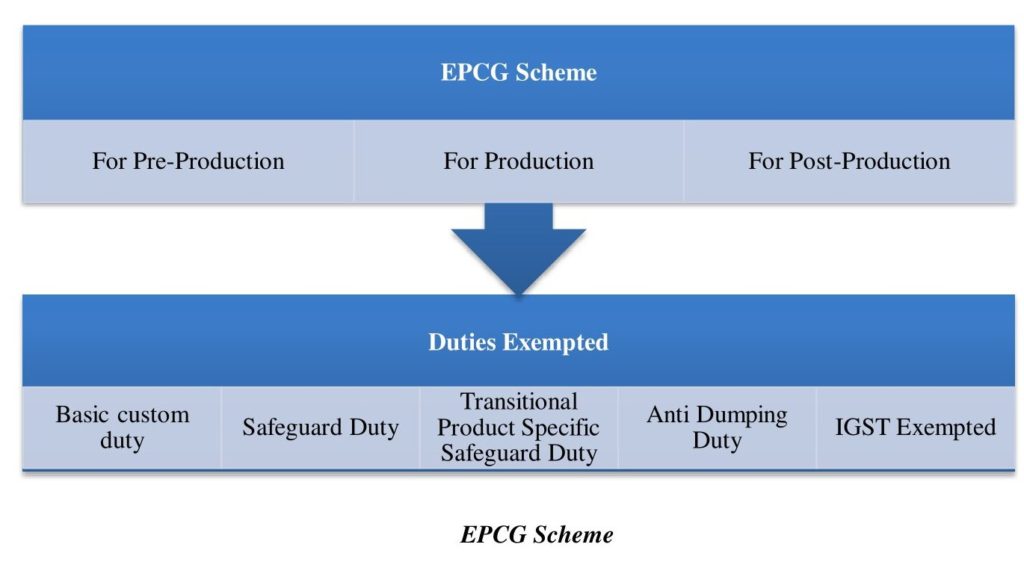
The Export Promotion Capital Goods (EPCG) Scheme allows businesses to import capital goods (machinery, equipment and accessories) at zero customs duty provided they commit to export finished goods worth multiple times the duty saved within a specified period. This “zero‑duty” regime helps Indian manufacturers upgrade technology without bearing high import costs and enhances the competitiveness of goods produced for export. It was introduced because high customs duties on imported machinery discouraged firms from investing in modern equipment.
Latest Updates
- Public Notice No. 51/2025-26 Dated 6th March 2026:
Extension in the Export Obligation Period for EPCG Authorisations – The Directorate General of Foreign Trade (DGFT) has announced an important relaxation for exporters under the EPCG Scheme. As per the latest public notice, the block-wise Export Obligation (EO) period for EPCG Authorisations that were expiring between 1st March 2026 and 31st May 2026 has been automatically extended until 31st August 2026. This extension has been provided in view of prevailing geopolitical developments affecting global trade and logistics. The relaxation is granted automatically and no separate application, amendment, or composition fee is required to avail this extension. - DGFT has issued a Policy Circular granting relief in Average Export Obligation (EO) under Para 5.17(a) of HBP 2023.
Sectors/product groups that witnessed a decline of more than 5% in exports during FY 2024–25 compared to FY 2023-24 are eligible for proportionate reduction in Annual Average EO for the year 2024-25.
Key Points:
• Relief applies only to sectors listed in the annexed export data showing negative growth.
• Regional Authorities will re-fix the Annual Average EO accordingly.
• The reduced EO will be officially endorsed in the EPCG authorisation file and amendment sheet.
• While processing EO discharge and EODC requests, relevant earlier policy circulars must also be considered.
Exporters holding EPCG Authorisations for FY 2024-25 are advised to review eligibility and approach the concerned Regional Authority for necessary amendment. - 21st January 2025 : Condonation of delay in submission of installation certificate under EPCG Scheme to promote Ease of Doing Business – reg.
The DGFT has allowed a one-time condonation for delayed submission of installation certificates under the EPCG Scheme for authorizations issued under FTP 2009-14 and 2015-20, permitting acceptance until December 31, 2023,
Eligible Capital Goods Under EPCG Scheme
Under the EPCG scheme you may import, duty‑free, any of the following:
Capital goods in any condition – new, semi‑knocked down (SKD) or completely knocked down (CKD) units.
- Computer systems and software that form part of the capital goods.
- Moulds, spares, dies, jigs, tools and fixtures.
- Catalysts for an initial charge plus one replacement.
- Other equipment needed for production, packaging, refrigeration, power generation, testing, research, quality and pollution control, as defined in FTP 2015–20.
According to FTP 2015–20, eligible industries include manufacturing, mining, agriculture, aquaculture, animal husbandry, horticulture, pisciculture, sericulture and floriculture, as well as service sectors like hotels or logistics. This breadth ensures that exporters in both goods and services can upgrade to world‑class technology while benefiting from duty concessions.
Watch this short introductory video on the EPCG Scheme; which explains the complex concept of EPCG in an easy to understand manner. It Explains What is EPCG Scheme and it’s application process; details about Export obligation & Redemption of EPCG License; entire summary and step by step procedures involved in the EPCG scheme.
Benefits & Eligibility for EPCG License Scheme
Under the EPCG scheme, eligible capital goods can be imported at zero customs duty, significantly reducing the exporter’s initial investment and improving cash flow. Additionally, exporters have the flexibility to either import machinery or procure it domestically; in cases of indigenous sourcing, domestic suppliers receive deemed export benefits, and the importer is eligible for a 25% reduction in specific export obligation, making local procurement an attractive option.
Who can apply for the EPCG scheme?
- Manufacturer Exporters: Must use imported machinery exclusively until export obligations are fulfilled; machinery cannot be sold or transferred during this period.
- Merchant Exporters: Must identify the supporting manufacturer and endorse their details on the licence and all shipping documents.
- Service Providers: Hotels, tour operators, logistics companies and construction firms may use EPCG licences to import equipment, reducing their capital costs.
Export Obligation under EPCG scheme
There are two obligations:
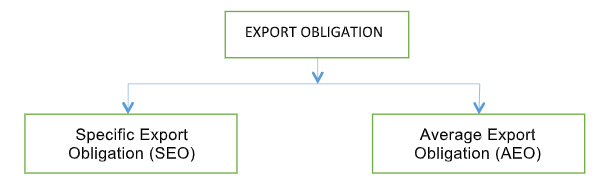
Export obligation under EPCG Scheme
- Average Export Obligation (AEO) – Maintain the average export turnover achieved in the three years prior to obtaining the licence. This ensures that the overall export performance does not decline after installing new machinery.
- Specific Export Obligation (SEO) – Export goods manufactured using the imported machinery worth six times the duty saved within six years from the licence issue date. If capital goods are procured domestically, the SEO is reduced by 25 %.
If obligations are not fulfilled within six years, a two‑year extension may be granted. Failure to meet obligations even after extension requires payment of all saved duties plus 15 % annual interest.
Export obligations can be met via direct exports, deemed exports, supplies to SEZs or EOUs, third‑party exports and service exports.
Exporters may elect to pay IGST and compensation cess on imports; this reduces the duty saved amount and thus the export obligation, provided the exporter does not claim IGST credit.
Licence Procedure & Application Steps
The Following image shows the whole process an organization has to go through to claim the benefits under the EPCG Scheme.
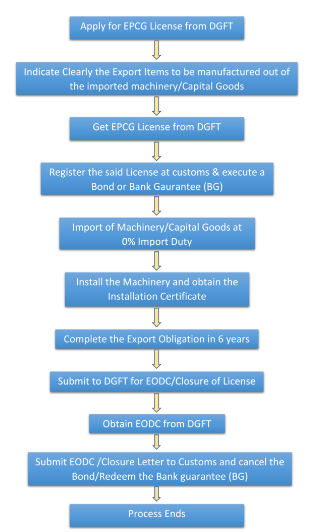
EPCG Procedure Flow Chart
Import timeline: Capital goods must be imported within 18 months of licence issuance; revalidation is not allowed.
Execution of bond/guarantee: A bond or bank guarantee must be filed with customs when importing.
Installation & certification: After installation, obtain an installation certificate from an independent Chartered Engineer and submit it to DGFT. A Chartered Accountant’s certificate verifying export turnover is also required.
Early closure: If 75 % of the specific export obligation and 100 % of the average export obligation are fulfilled in half the time, the remaining obligation can be waived and the licence closed.
Redemption: Once obligations are met, obtain a redemption letter from the regional DGFT authority. This releases the bond/bank guarantee.
How to apply for an EPCG License online?
- Prepare prerequisites: Ensure IEC/RCMC show you as a manufacturer exporter and list the correct factory address. Obtain MSME/SSI proofs showing the products to be exported.
- Visit DGFT portal: Go to the DGFT website (www.dgft.gov.in), log in using Digital Signature Certificate (DSC), and select “Online E‑com Application.”
- Select EPCG (0 %) and fill in all details. Upload necessary documents (see list below).
- Check document accuracy: Confirm IEC/RCMC, MSME proofs, and machine details are correctly entered.
- Submit the application. Once approved, DGFT issues the EPCG licence digitally.
Documents required
- Pro forma invoice or purchase order for the capital goods.
- Copies of IEC, RCMC, MSME registration, GST certificate and (if applicable) central excise registration.
- Details of capital goods: HSN code, model number and technical description.
- List of export products with HSN codes.
- Chartered Engineer certificate linking machinery to the export product.
- Chartered Accountant certificate showing turnover for the past three financial years.
- Factory address where machines will be installed.
- Process flowchart showing where machinery will be used.
How we assist
We assists exporters in smoothly navigating the EPCG scheme by clearly explaining scheme conditions and export obligations to help them make informed decisions, preparing and filing complete licence applications, coordinating with DGFT for issuance, amendments, revalidations or extensions of licences, guiding clients on post-licence compliance requirements, and obtaining redemption letters along with release of bonds or bank guarantees after successful fulfilment of export obligations.
FAQ
What is EPCG scheme?
In EPCG Scheme, the exporter can import capital goods duty free i.e. Zero custom duty and one has to export finished goods worth 6 times of the actual duty saved value in 6 years. The main goal of the EPCG Scheme is to improve India’s competitiveness in the manufacturing sector.
What is EPCG license?
The duty free authorization issued by DGFT RA is called EPCG License. It is Non-transferable license. It is used to import duty free capital goods.
What is zero duty EPCG scheme?
Zero duty EPCG Scheme allows import of capital goods for pre-production, post production and production at zero customs duty, subject to an export obligation equivalent to 6 times of actual imported duty-saved value in 6 years.
How to get EPCG License from DGFT?
In order to obtain an EPCG License from DGFT, the primary requirement is to file an online application with the RA of DGFT with DSC. While applying online application all the necessary documents are required to be uploaded. We have an experience team who can help you in applying for EPCG License.
Is EPCG scheme advisable?
Maintenance of Average Export Obligation is a major problem in EPCG Cases which we come across regularly. Therefore If the Company is sure to achieve stable export orders in the years to come, then the EPCG Scheme is a very good option for them.
Can a new Exporter avail the EPCG Scheme?
Yes, the Average Export Obligation imposed in such cases will be zero.
What is Post Export EPCG Duty Credit Scrips?
This scheme is beneficial for those Exporters who intend to pay all the duties in cash at the time of Import and after fulfilling an Export Obligation, then claim the benefit of duty-free in the form of Duty Credit Scrips.
What is EPCG license registration procedure?
On receiving the EPCG License from DGFT the next step would be to register the license at Customs. It is not possible to clear the machinery duty-free unless you register the license at the port where the consignment will arrive. License is registered to the port of customs as mentioned in the license.
Is it mandatory to register EPCG license at Customs?
Yes, it is mandatory to register EPCG License at customs.
Is any amendment/Changes in EPCG License possible after it is issued? If yes, explain what can be amended?
Yes, we can amend the EPCG License and below are the details-
- If the Authorization holder has received the license but wanted to procure indigenously, the holder can amend the license and take an invalidation letter.
- Due to changes in contract or increase in the value of imported capital goods, there will be a change in CIF value so we can amend the license.
- Some time we are unable to import due to some or the other problem and the validity of import is going to expire so we can apply for revalidation of license.
- Sometimes we want to add a new export product in the EPCG License due to some or the other reason. In such cases also, an EPCG license can be amended and new export products can be added.
When can a shipment be counted under EPCG Scheme?
The following details should be mentioned in the shipping Bill to be counted in EPCG Scheme,
- EPCG License No. Should be mentioned in the shipping bill,
- Export Product with ITC HS code mentioned in the shipping bill should be the same as on License.
Can Capital Goods/machinery under the EPCG Scheme be procured indigenously/From the Domestic Suppliers? If yes, what is the advantage to both Domestic Supplier and the EPCG Authorization Holder?
Yes, Capital Goods/ machinery can be obtained from Domestic Suppliers with the help of an Invalidation Letter.
- Benefit to Domestic Supplier – he can claim the benefits of Deemed Exports against such supplies.
- Benefit to EPCG Authorization Holder – Specific Export Obligation will be decreased by 25% and such supplies will not attract GST until 31.03.2021. (Date may be extended from time to time).
Can shipments exported under Advance Authorization/Duty Drawback/DFIA/MEIS be counted towards EPCG EO fulfillment?
Yes, we can calculate the shipping consisting of Advance Authorization/Duty Drawback/DFIA/MEIS No. to be counted in EO fulfillment only if EPCG license no. is mentioned. It means that the EPCG Scheme can be combined with any other export promotion scheme.
What are the compliances to be followed after obtaining an EPCG License from DGFT?
After obtaining an EPCG license from DGFT, it has to be registered at Customs. Once capital goods is cleared duty-free from Customs, it has to be installed at the said factory premises. An Installation Certificate has to be obtained from the Independent Chartered Engineer or Customs authority as a proof of Installation & commissioning. Once production starts, applicant should complete the export obligation in given time frame and submit all the export documents to DGFT office to close the EPCG license.
What is the Installation Certificate under EPCG Scheme? What are the conditions associated with it? Explain in detail.
An EPCG Authorization holder needs to install the capital goods imported within a period of six months in front of an Independent Chartered Engineer. The chartered engineer will check that as per the authorization capital goods have been installed in given factory / supporting manufacturer premises or not and also cross verify the capital goods imported details with the license. And as per the verification, he will generate a certificate mentioning company name, Imported capital goods with quantity, BOE details, capital goods installation date on his letterhead with signed and stamped. The certificate generated by an Independent Chartered engineer is called the Installation Certificate. The same original copy should be submitted in DGFT and customs and receive the acknowledgment for the same.
What is export obligation?
Export Obligation is a task/job given by the DGFT to the applicant to export certain value of goods in certain time frame. Export obligation is mandatory to be fulfilled.
Can Export Obligation under EPCG Scheme be fulfilled by the Export of alternate products? (i.e. By the Export of products not manufactured out of the Imported machinery)
No, in the current Foreign Trade Policy 2015-21, there is no provision to fulfill export obligation through alternate products. Export Obligation will be completed only with those finished goods produced from imported capital goods mentioned in the EPCG License.
Can Deemed Exports be counted towards the fulfillment of Export Obligation under EPCG Scheme?
Yes, Deemed export is counted towards fulfillment of Export Obligation under EPCG Scheme. Supply to EOU/STP/EHTP/BTP Unit is called as deemed export and can be counted towards EO Fulfillment along with supply to SEZ units.
Can Third-party Exports be counted for Export Obligation (EO) fulfillment?
Yes, but in such cases Shipping Bill / Bill of Exports should contain the name of Third Party along with EPCG Authorization number.
How is the calculation of Export Obligation done under the EPCG Scheme?
In case of direct export, EO is calculated as 6 times of actual duty saved value. And in domestic sourcing, EO is calculated as 6 times of duty save value calculated as per notional custom duty on FOR Value.
Can the Export Obligation period of 6 years under the EPCG Scheme be extended?
Provisions for extension in the EO Period shall be governed as per the EPCG license issue date. For example, the EPCG License issued prior to the notification of FTP 2015-20 shall be governed by relevant provisions of HBP Vol 1 applicable at the time of issuance of EPCG Authorization. As per Current Policy in place – Yes, We can extend the Export Obligation period by two years after completion of 6 Years (6+2=8 Years). We can extend by paying a composition of 5% for the first year and 10% for the second year on the proportionate Duty saved value on pending / unfulfilled Export Obligation. But the minimum composition fee to be paid is Rs. 10,000/-. Alternatively, if the Exporter doesn’t want to pay the composition fees and has procured new export orders. He can enhance the EO by 10%/20% for the first/second-year respectively. In such cases, no composition fees will be required.
If the Export Obligation is still not completed in the extended period of 2 years. Can the EO be extended further?
Further extension of EO after (6+2=8 Years) is difficult. You have to apply to the EPCG Committee at DGFT New Delhi for an extension. The extension can be granted of an additional 2 years in case of genuine hardships only.
What if the Specific Export Obligation is not fulfilled even in the extended EO period, but Average Export Obligation is fulfilled?
If the authorization holder failed to fulfill the specific export obligation but maintained average export obligation, the holder has to pay proportionate Duty Saved Amount with 15% annual interest on pending specific export obligation on actual imported capital goods at customs and submit the proof of duty paid to license authority concerned.
What if Average Export Obligation is not fulfilled, but Specific Export Obligation is fulfilled?
If Average Export Obligation is not fulfilled, but Specific EO is fulfilled, Then Entire duty saved amount with 15% annual interest should be paid at Customs and submit the proof of duty paid to DGFT for regularization.
What is Block-wise Export Obligation under the EPCG Scheme?
There are two types of Export Obligations – Average Export Obligation and Specific Export Obligation. We have to maintain both the obligation. While maintaining specific export obligations, we have to fulfill block-wise as per given below table and same we have to submit to DGFT.
| Period from thr date of issue of EPCG License | Minimum specific export obligation fulfilled |
| 1st Block(1st to 4th year) | 50% |
| 2nd Block(5th and 6th year) | Balance/ Pending Specific EO |
What is the incentive for the early fulfillment of Export Obligation?
If the Authorization holder has fulfilled 100% Average Export Obligation each year from the issue of license and 75% or more of Specific Export Obligation in half or less than half of the original Export Obligations period, the holder can redeem the license as per para 5.09 FTP.
Is there any exemption from the maintenance of Average Export Obligations?
If the EPCG Scheme is availed for the below mentioned Export products, then the average export obligation will be exempted:
- Handicrafts,
- Handlooms,
- Cottage & Tiny sector
- Agriculture
- Aqua-culture (including Fisheries), Pisciculture,
- Animal husbandry,
- Floriculture & Horticulture,
- Poultry,
- Viticulture,
- Sericulture,
- Carpets,
- Coir, and
- Jute.
Apart from the exemption to the above sectors, relaxation is also provided to such sectors where the global growth rate has declined more than 5% for a particular FY.
What is the next step after Export Obligation is fulfilled?
The next step is to close the EPCG License and apply for redemption/Closure. We need to fill the redemption form ANF 5B along with the specified documents mentioned in the form and submit it with the original license at the DGFT RA for Closure.
What is EPCG Redemption?
EPCG Redemption or EPCG License closure procedure is a mechanism through which the DGFT monitors the fulfilment of the export obligation given to holder by the Government. We can help you in closure of EPCG License by preparing correct documents as per DGFT Rule.
How to redeem/close EPCG license?
The License holder has to fill the redemption form of ANF 5B with the relevant documents mentioned and submit to DGFT RA. The DGFT will issue a closure certificate called Export Obligation Discharge Certificate.
Do you help in redemption of EPCG license?
Yes, we do help in redemption of EPCG License.
Can we surrender/cancel EPCG license if not used for duty-free import?
We can surrender the EPCG License, if the holder does not want to import capital goods by submitting the relevant documents. We can help you in preparing and submitting the documents for surrender at DGFT.
Is EPCG License transferable?
No, EPCG License is not possible to sell.
Can we sell EPCG license?
What is the validity of EPCG license?
The import validity of EPCG License is 2 years and export validity of EPCG License is of 6years from the issue of license.
Why Choose Afleo?
- Comprehensive Support: We handle documentation, licence applications, amendments and redemption, minimising delays.
- 24/7 Service: Our team is available around the clock for urgent issues or compliance questions.
- DGFT Expertise: Dedicated staff familiar with DGFT procedures ensure smooth licence issuance and closure.
- Updates & Insights: We maintain an active social media presence to keep clients informed of the latest foreign trade policies and circulars.